When Robert and Eleanor Campbell sat down to inventory their insurance policies, they found something they had stopped seeing years ago: a whole life policy that still named, as its beneficiary, a relative who had been dead for twelve years.
Nothing about the policy looked wrong from the outside. The premiums were paid. The statements arrived on schedule. Their estate plan was current, professionally drafted, and carefully considered. But if either of them had died before that afternoon, the payout would have gone hunting for a person who no longer existed, and their family would have inherited a legal tangle instead of a check.
One phone call to the insurer fixed it. The call took less time than reading this article. It happened only because someone finally looked.
Does a beneficiary designation override a will?
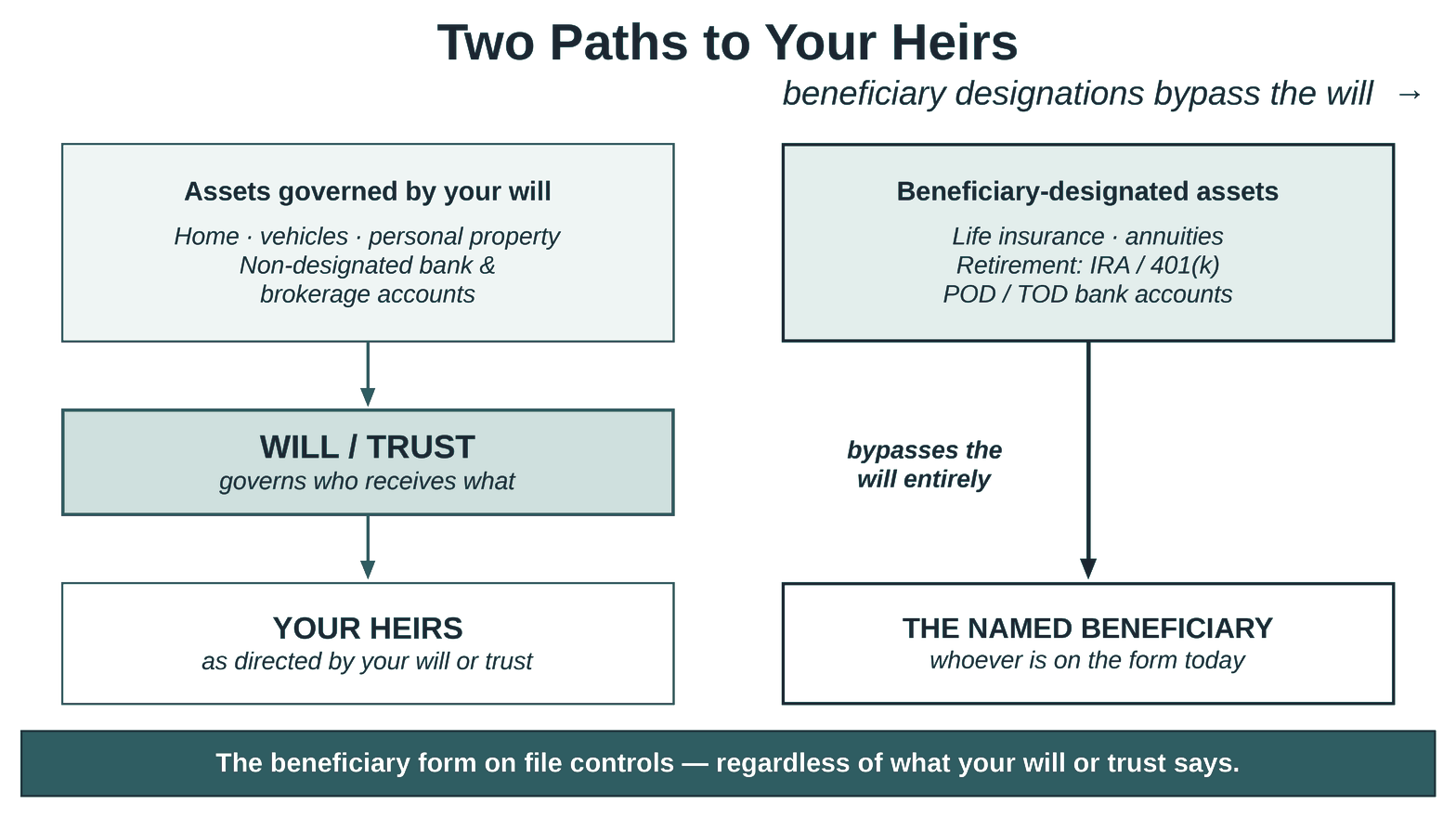
Yes. Retirement accounts, life insurance policies, annuities, and payable-on-death (POD) bank accounts pass outside your will. They go directly to whoever is named on the beneficiary form, regardless of what your will or trust says. Your will doesn’t control your biggest accounts; the form does.
Most families find this genuinely counterintuitive. They assume the will governs everything, and a will, however carefully drafted and however much it cost, cannot override that form. And for many households, the accounts that pass by beneficiary designation (the 401(k), the IRA, the life insurance) are the largest assets they own. Which means it is entirely possible to spend real money on a thoughtful estate plan and then quietly undo part of it with a fifteen-year-old form naming an ex-spouse, a deceased parent, or a minor child with no trust in place. The money routes to the wrong destination silently, and no one notices until it is irreversible.
This is not a rare oversight, and it is not a careless one. Beneficiary forms get filled out on the day an account is opened, usually in about ninety seconds, and then they disappear from view. Life keeps moving. The form doesn’t.
Two habits that keep beneficiary designations honest
The FIRM System (FIRM stands for Family Information Resource Management, the organizational system at the heart of The Recoverable Family) addresses this with two small habits, both of which live in Area of Focus 3: Financial.
First, record the designation when you record the account. As you inventory each account in the Financial Accounts Module and each policy in the Insurance Module, note two things alongside the account details: whether a beneficiary is designated, and whether that designation still reflects your wishes. You are not copying the form into your records. You are recording that you checked.
Second, review every designation at three moments: whenever you update your estate plan, whenever a major life change happens (a marriage, a divorce, a birth, a death), and at your annual review. Note the date each time. A one-line entry does the whole job: “beneficiary confirmed as [name] on [date].” Writing it takes thirty seconds.
The value here is not the paperwork. It is the looking. The Campbells’ policy sat wrong for twelve years because nothing in their financial life ever prompted anyone to open that particular drawer. An inventory prompts you. That is the entire mechanism: the act of recording forces the act of checking, and the act of checking is what catches the error while it is still a phone call instead of a probate case.
Who inherits your 401(k)? Check one account today
Whoever is named on the beneficiary form inherits your 401(k), and that may not be who you think. So pull up one account today. Your 401(k), or your main life insurance policy, whichever is bigger. Log in, or call the number on the statement, and look at the named beneficiary.
Is it current? Is it the person you would choose today?
If yes, write the one-line entry and enjoy the rest of your day; you have just completed what may be the highest-value thirty seconds in your family’s entire financial plan. If no, updating the beneficiary takes a form or a phone call — the same call Robert and Eleanor made. Either way, you now know something most account holders don’t: what your biggest asset will actually do.
Where Financial meets Estate
Beneficiary designations sit exactly where Area of Focus 3: Financial meets Area of Focus 4: Estate. These forms shape how your assets are distributed in a way that bypasses the will entirely, so they belong in both conversations. The Financial Accounts Module and the Insurance Module document what exists and who is named. The Estate Plan Module coordinates those designations with your attorney, so the forms and the legal documents point in the same direction instead of quietly contradicting each other.
This is also one reason the FIRM System puts estate planning last, not first: decisions like beneficiary designations get sharper when the inventory comes before the attorney’s office, not after.
Not sure where your family stands today? Find out in two minutes: Emerging, Developing, or Recoverable. Take the Self-Assessment.