The most common way families try to get organized is to start with a list. Someone opens a spreadsheet, a notes app, or a fresh notebook and begins writing down everything they can remember: accounts, passwords, contacts, account numbers, where the safe-deposit box is, who the attorney is.
This feels productive. Lists feel like progress. But within a few weeks most of these efforts stall, and when the family comes back to the list, the list itself has become the problem. It lives in a notes app on one person’s phone. Or in a document shared with a spouse and, by now, with whoever else was ever sent the link. Or in a notebook in a kitchen drawer, next to the takeout menus. The information is real. The container is wrong.
Most advice about organizing family information starts in the same place: make a list of your accounts, write down your passwords, fill in a binder. That advice is not wrong about what belongs on the list. It is wrong about when the list comes. The list is the third step, not the first.
The build order
The FIRM System, the architecture at the heart of The Recoverable Family, exists to prevent exactly this failure. The fix is not a better list — it is a different order of operations. There is a build order, and it does not bend.
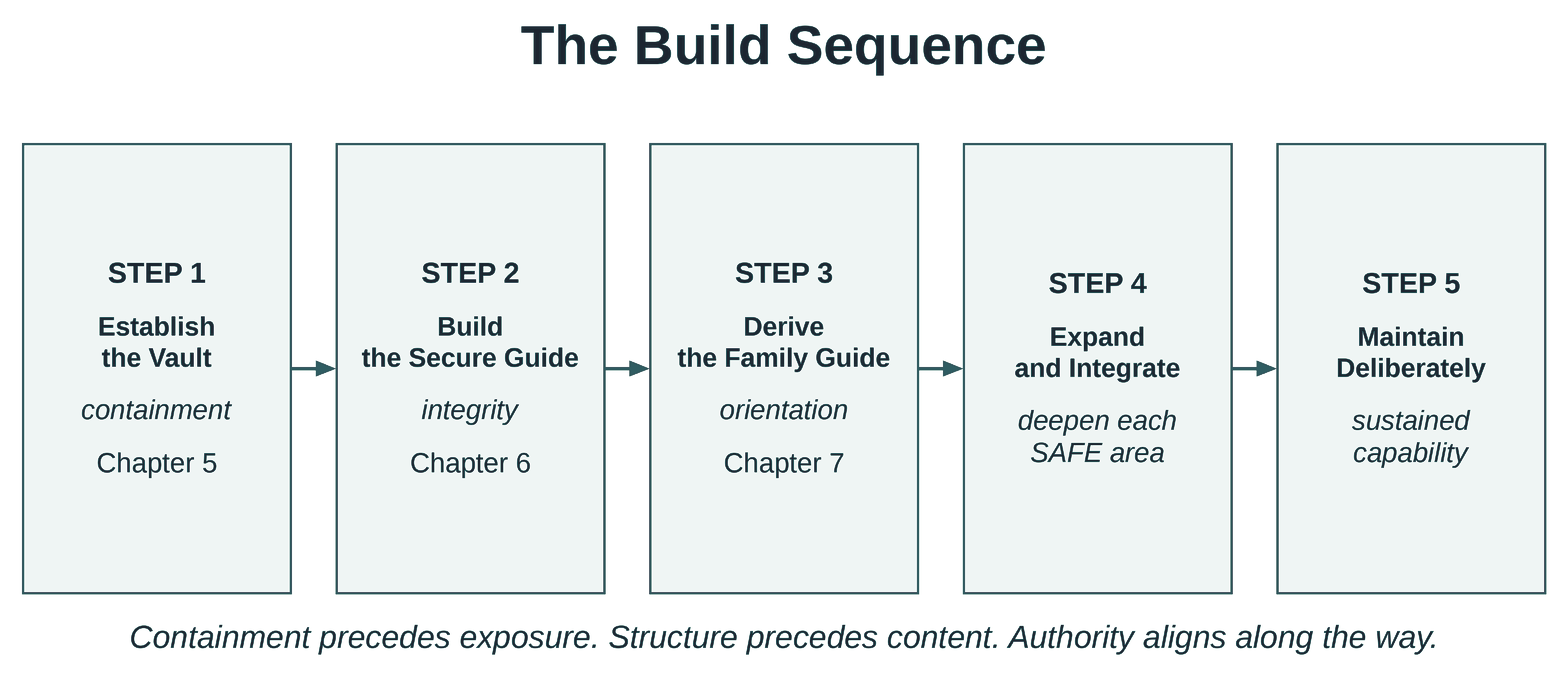
- The Vault comes first. Before a single password is recorded or a single account is listed, there has to be a place, physical or digital or both, that is locked, controlled, and structured to hold what comes next. The Vault is not a document. It is the container. A fireproof home safe with a printed guide inside it is a Vault. A password manager organized under the four SAFE Areas of Focus is a Vault. An encrypted folder is a Vault. What they share is not technology or price. It is the deliberate act of placing sensitive information inside a boundary that controls who can reach it, and the Vault Key Rule is what keeps that boundary honest.
- The Secure Guide comes second. Once the container exists, the gathering begins. The Secure Guide is the family’s authoritative internal record: credentials, sensitive documents, access logic, estate details, identity information. It is built for integrity, not for sharing. The goal at this stage is completeness. The Secure Guide has to be whole before it can be filtered.
- The Family Guide comes last. And the verb matters: the Family Guide is derived, not written from scratch. It is extracted from the Secure Guide by filtering out everything sensitive and keeping everything that orients. The two-minute test is the filter. What remains is the map, not the key: the document that can sit on the kitchen table without putting anything at risk, because everything sensitive stays inside the Vault.
Why each layer depends on the one beneath it
A Family Guide assembled before the Secure Guide exists is a list of pointers to nothing. A Secure Guide built before the Vault exists is sensitive information stored in whatever happened to be at hand: a notes app, a shared drive, an unencrypted file on a laptop. Each of these is a containment failure. Not because the intent was wrong, but because the structure was not in place before the information was.
Families that reverse the order can recover. But they almost always have to reorganize from scratch, moving sensitive material into a secure location after the fact, often incompletely, with the original list now scattered across tools that were never designed to hold it. Going in order is cheaper than going back.
A diagnostic, if you have already started
Ask where your most sensitive information lives right now. Not the important information, the sensitive information: the lines that would cause harm if a guest, a contractor, or a stranger with a link could read them.
If the answer is a notes app, an unencrypted document, an email thread, a spreadsheet, or a shared drive that anyone with the link can open, your container is not a Vault, however careful the list inside it is. The next step is not to add to the list. It is to stand up the container and move what you have into it. A spreadsheet of family passwords is a Secure Guide without a Vault, and that is the most common shape of a family information system that has not failed yet.
If the answer is a password manager, a locked safe, or an encrypted folder with a controlled key, you have a Vault. The question becomes whether what is inside it is complete, and whether anyone besides you could find their way to it. That is the Family Guide’s job, and it begins with the orientation section.
The order is fixed. The implementation is yours.
Nothing in the build order dictates a product. A paper safe with a printed Secure Guide inside it and a single-sheet Family Guide on the refrigerator is a complete FIRM System. So is a password manager with a derived, shareable summary kept beside it. The components are the same. The means are the family’s choice.
The same discipline carries forward once the three artifacts exist. The FIRM System then expands one SAFE Area of Focus at a time, and that sequence has its own logic, System first and Estate last, for reasons explained in the companion piece. Then it is maintained deliberately, on a calendar, not when a crisis reminds you. Containment precedes exposure. Structure precedes content. The list, when it finally comes, has somewhere to live.
Quick reference: the build order
- Stand up the Vault. A safe, a password manager, or an encrypted folder. Controlled access before any content.
- Gather into the Secure Guide. Every credential, document location, and access instruction, inside the Vault, complete before it is filtered.
- Derive the Family Guide. Filter the Secure Guide with the two-minute test. Keep what orients. Leave what exposes.
- Then expand, one Area at a time, and maintain on a schedule.
If you already have a list, keep it. Just see it for what it is: raw material for step two, waiting for step one. The order does not bend.
If you want to know which step your family is actually on, the free Recoverability Self-Assessment answers in about two minutes.