Picture the moment most estate plans are quietest about. You are alive. You are in a hospital, unable to communicate, and decisions need making: bills paid, insurance kept current, treatment chosen. Your family reaches for the document you told them proves you have a plan.
Your will does nothing. Not because it was badly drafted, and not because you made a mistake. A will has exactly one activation condition, and you have not met it. While you are alive and incapacitated, the will sits inert, and the authority your family needs in that room belongs to a different document, held by a different person.
Do you need more than a will?
Yes. A will is one of four kinds of legal authority your family needs, and it operates only after your death. A durable power of attorney, a healthcare power of attorney with an advance directive, and a digital executor cover the situations a will cannot, including incapacity while you are alive.
“I have a will, so I’m covered” is the most common estate-planning misconception, and it is an understandable one. The will is the document everyone has heard of, the one that gets the attorney appointment and the signing ceremony. But the four kinds of authority switch on at different moments. Some operate only while you are alive. Some operate only after you die. A family holding one of the four is not one-quarter covered; it is covered for exactly one situation and exposed in the others.
None of this requires wealth, and none of it should alarm you. It requires knowing what each document does, and when.
The four estate planning documents (and when each one kicks in)
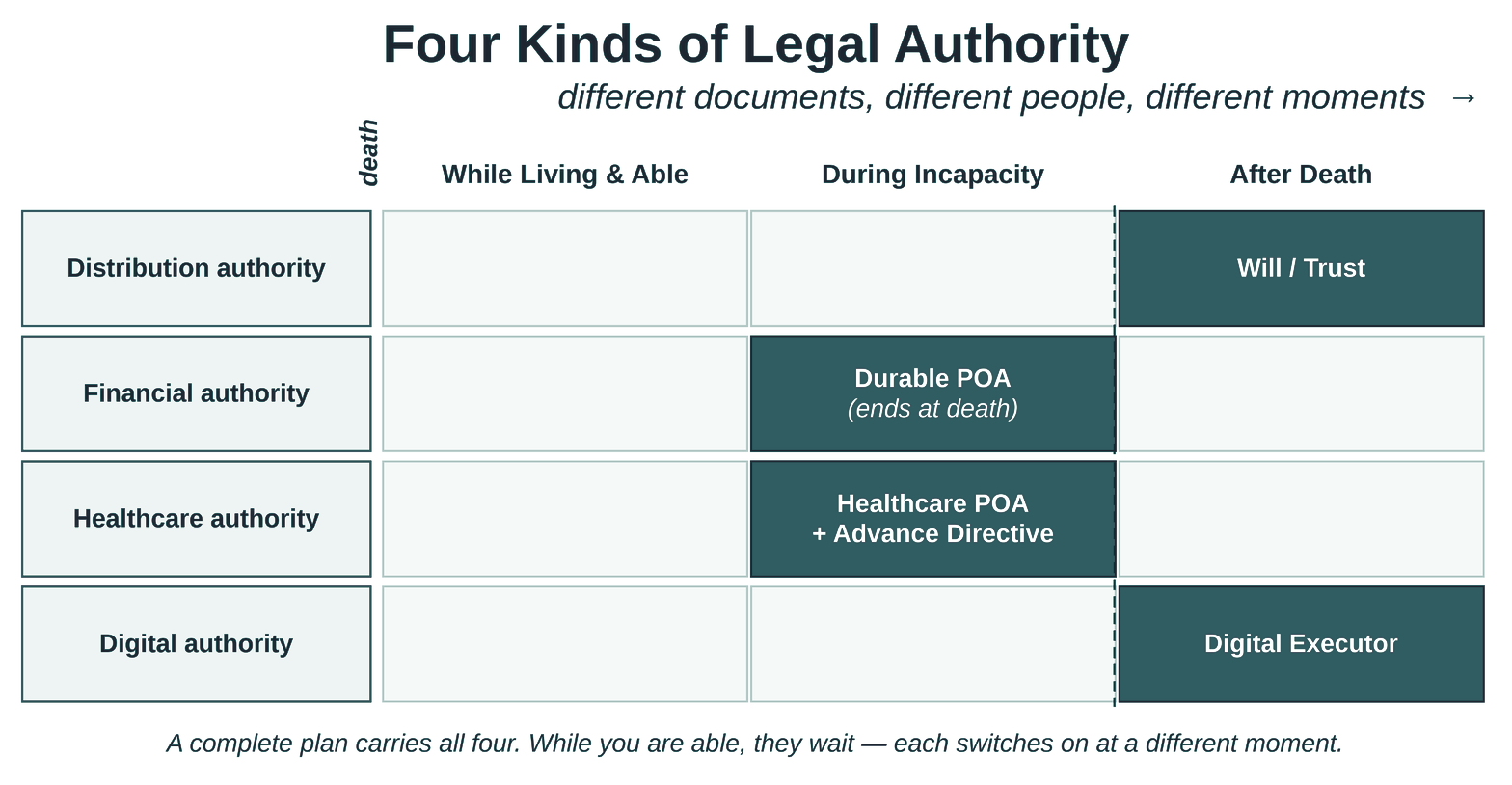
1. Distribution authority: the will and the trust (after death)
A will, or a revocable living trust, directs who receives what after your death and names the person empowered to carry it out: the executor, or the successor trustee. Two boundaries are worth knowing. First, it has no effect during your lifetime. Second, it does not control everything even after death: assets with beneficiary designations, such as retirement accounts, life insurance, and payable-on-death accounts, bypass both the will and the trust and pass directly to whoever is named on the form.
2. Financial authority: the durable power of attorney (during incapacity)
A durable power of attorney names an agent who can act financially on your behalf while you are alive but unable to act yourself: paying the mortgage, managing accounts, keeping the household running. “Durable” is the word doing the work; it means the authority survives your incapacity instead of evaporating exactly when it is needed. And it terminates at your death — the moment the executor’s authority begins. That is the difference between a power of attorney and an executor: your agent acts for you while you are alive, and your executor acts only after you die. The two form a relay, and different people may be holding the baton on each leg.
3. Healthcare authority: the healthcare power of attorney and advance directive (during incapacity)
These two documents work as a pair. The healthcare power of attorney names who makes decisions about your medical care if you are incapacitated. The advance directive records what you would want, so that person is guided by your wishes rather than guessing under pressure. Like the financial power of attorney, both operate only while you are alive and unable to speak for yourself.
4. Digital authority: the digital executor (after death)
Your accounts, photographs, files, and online presence need someone named and legally empowered to handle them after your death. Traditional estate documents often never mention them, and without explicit authorization, even a diligent executor can find themselves locked out of the very accounts they need to settle. Naming a digital executor, and granting that access in your estate documents, closes the gap.
Four documents, one common failure
Here is where a complete document set still fails: nobody can find it. A power of attorney your agent cannot locate during a crisis authorizes nothing. An advance directive sitting in an unopened drawer guides no one.
The FIRM System (FIRM stands for Family Information Resource Management, the organizational system at the heart of The Recoverable Family) treats this as the first principle of recoverability: if it cannot be found, it cannot be used. Making the four authorities findable is the job of the Family Guide, a high-level map for your family that records what documents exist, where each one lives, and who to call. It holds no passwords and no legal language. It simply ensures that the person holding each authority can reach the paper that proves it.
Your first step
Take one page and write the four authorities down the side: distribution, financial, healthcare, digital. For each, answer three questions. Does the document exist? Who holds the authority? Could that person find it without calling you?
Most families discover at least one gap. That is not a failure; it is a finished agenda for your next attorney visit, which is more than most clients walk in with.
Where this lives in the FIRM System
All four authorities are documented in the Estate Plan Module, in Area of Focus 4: Estate. They come last in the system deliberately, because estate planning works best after the inventory, when you arrive at the attorney’s office knowing what you own and what you want each document to do.
Wondering which situations your family is covered for today? Two minutes tells you where you stand: Emerging, Developing, or Recoverable. Take the Self-Assessment.