An estate attorney billing $400 an hour does two very different kinds of work, often in the same meeting. The first is judgment: weighing a trust against a will for your particular situation, spotting the jurisdictional wrinkle you would never have seen, structuring authority so it holds up under pressure. That work is why you hired them. The second is extraction: establishing which accounts you hold, which documents already exist, where the old policies live, and who is currently named on what. That work is information archaeology, and it bills at exactly the same rate as the judgment.
The most expensive thing you can do with a $400-an-hour estate attorney is make them do archaeology. Not because the attorney is doing anything wrong; excavation is genuinely necessary when a client arrives without a map, and a careful attorney will insist on it. But every hour spent reconstructing your information is an hour not spent applying the expertise you actually came for. Preparation is what decides which kind of hour you buy.
How do you prepare for an estate attorney meeting?
Organize first, then engage. Get your information in order before the meeting and bring it with you: what you own, what documents exist, and where things live, plus the questions you want judgment on. A prepared client moves extraction work off the clock, so the attorney spends the hour on legal judgment instead of reconstruction.
The fix is a matter of sequence, not spending. Get your information in order first: the Vault populated with credentials, the Secure Guide structured so it explains how your household actually runs, the Family Guide derived from it as the high-level map of what exists and who to call. Then engage the attorney, the CPA, the financial advisor, or the security professional.
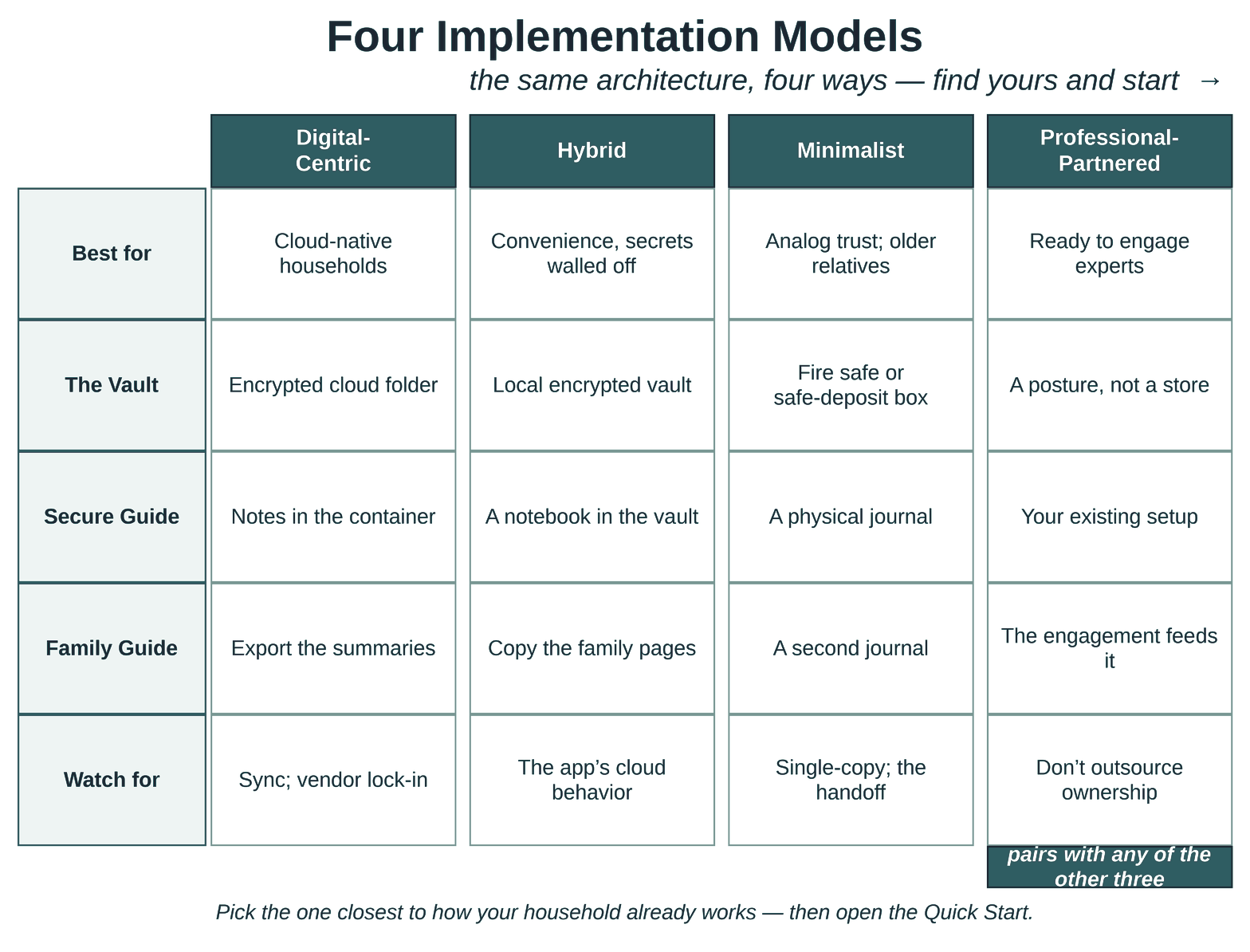
This is what the FIRM System (FIRM stands for Family Information Resource Management, the organizational system at the heart of The Recoverable Family) calls the Professional-Partnered Model: one of four ways families implement the system, and the one where organized family records meet paid professional judgment. The order of operations is the whole point. Professionals multiply the architecture — they don’t substitute for it. A professional who arrives to organized inputs spends their billable hours on strategy and judgment instead of on excavation, and your preparation is precisely what unlocks that value.
Organized does not mean finished. You do not need every part of the system complete before you make the appointment. What to bring to an estate planning appointment is a shorter list than most people expect: a current account inventory, a list of the documents you already have, and a one-page map of where things live. Those three things will move most of the extraction work off the clock by themselves. What matters is that the raw material arrives with you instead of being dug out of you.
Arriving organized also changes the conversation itself. Instead of spending the first meeting telling each professional what you have, you get to ask what to do with it. Here is what that sounds like, professional by professional.
Questions to ask your estate attorney (and your other professionals)
Your estate attorney
Bring the Family Guide and your document inventory, and ask three things. What decisions remain unmade for our situation? Which of the documents every family needs are we still missing, and which existing ones need updating? And what jurisdictional issues apply to us: state-specific rules, property in more than one state, an out-of-state executor? Every one of these is a judgment question. They are exactly what an hour of legal expertise is for, and none of them can be answered well for a household the attorney is still trying to see.
Your CPA or tax professional
Show them the financial and tax sections of your Secure Guide and ask two questions. What does this already capture that you need from me every year? And what is it missing? A CPA who can see your whole documented picture can point at the gaps in minutes; a CPA reconstructing it from a folder of statements is doing archaeology too, at tax-season rates.
Your financial advisor
Bring your account inventory and ask for two reviews. First, beneficiaries: here is every account and who is named on each, so does every designation still match the rest of the plan? Second, consolidation: which of these accounts could be combined, and what would that simplify for the people who will someday have to manage them?
A security professional
If your household’s digital footprint warrants it, ask for a threat-model review (what are the realistic risks to how our information is stored and shared?) and an audit of your encryption and backup arrangements. You are not asking them to build your system. You are asking them to pressure-test the one you built.
Your first step
Look at your calendar and find the next professional appointment you already have: the tax visit, the policy review, the long-postponed attorney meeting. Prepare one page for it. Not the whole system, just one page listing what exists in that professional’s domain, where it lives, and the two or three questions above. One prepared page will change the texture of that hour, and it will show you, at small scale, what the full architecture does at every scale.
Where this lives in the FIRM System
The attorney relationship itself gets documented in the Estate Plan Module, in Area of Focus 4: Estate: who your professionals are, what they hold, and what was decided when. That record is what turns a good meeting into something your family can find and act on later, which is the entire test of recoverability.
Where does your family stand before the next appointment: Emerging, Developing, or Recoverable? The Self-Assessment tells you in two minutes.