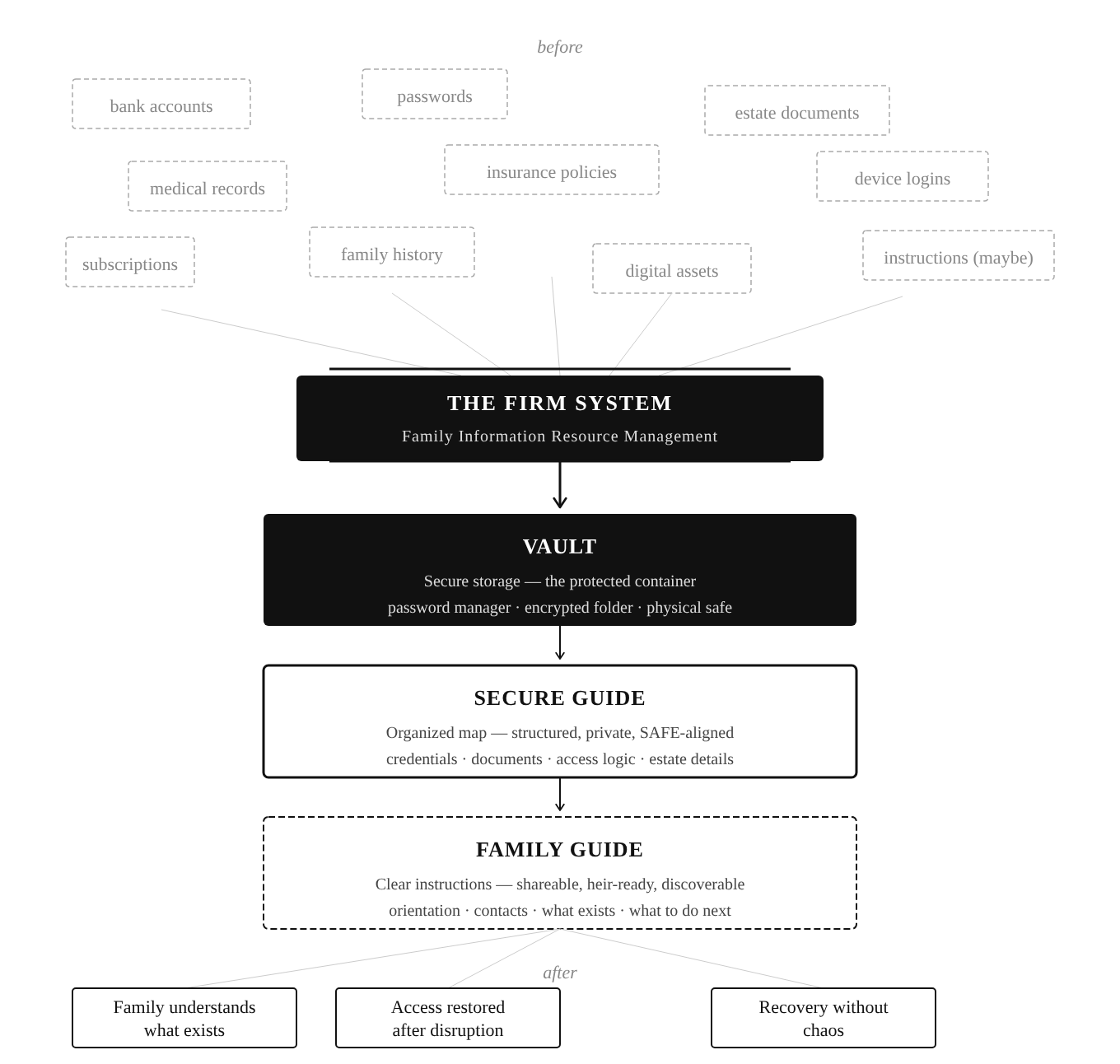
Start at the top of the picture. A drawer of cables, half of them for devices the family no longer owns. Passwords on a sticky note under the keyboard, or in the memory of the one person who set everything up. A filing cabinet nobody has opened since the move. An insurance policy that lives in an email from three phones ago. Bank accounts, medical records, estate documents, the family photos on a drive in a closet, and somewhere, maybe, a page of instructions.
Every household has a version of this picture, including the one this site comes from. It is not carelessness. Each item arrived at a different moment, in a different format, and nothing was waiting to receive it. The scatter is simply what information looks like when it has never been given a home.
What the scatter actually costs
Being overwhelmed by family paperwork is a reasonable response to this picture, and it is not about volume. The costs are specific: the twenty minutes spent hunting for a policy number, the renewal you did not mean to pay, the afternoon lost to a password reset. And the cost that gives this site its name: the day something goes wrong (a stolen phone, a hospital stay, the one person who knew where everything was is away) and the family discovers that the information exists but cannot be reached. It is a findability problem, not a tidiness problem.
Why a weekend purge does not fix it
Most advice treats the picture as clutter: block a Saturday, buy a binder, label the drawer. A purge produces a tidier version of the same scatter, and within a month the new binder is one more place things might be. The list comes third: the container comes first, and the picture resolves only once each item has somewhere to go. And if the drawer stays shut for reasons that feel heavier than tidiness, that has a name too, and it is not laziness.
What is family information management?
The FIRM System (Family Information Resource Management) is the organizational system at the heart of The Recoverable Family, built so that the right people can find the right information at the right time. The SAFE Framework divides a family’s information into four Areas of Focus: System, At-Home, Financial, and Estate. Together they turn the top of the picture into the bottom of it.
Reading the picture from top to bottom
In the middle of the graphic, every item passes through the FIRM System and lands in one of three layers.
The Vault is the protected container: a password manager, an encrypted folder, a physical safe. Secrets live here and nowhere else. It is the first thing a family builds, before a single list.
The Secure Guide is the organized, private map: which accounts and documents exist, where the originals are, how access works, arranged by the four Areas. It lives inside the Vault.
The Family Guide is the plain set of instructions a trusted person can read without a key: what exists, who to call, what to do next. It can survive a kitchen counter, and one two-minute question decides what belongs in it.
Beneath the layers sit the three outcomes the picture promises: the family understands what exists, access is restored after a disruption, and recovery happens without chaos.
You are not disorganized. You are Emerging.
The book describes three maturity levels, and they are worth knowing because they replace a verdict with a location.
- Emerging: informal and scattered. Key knowledge lives in memory or in scattered places, and the household depends heavily on one person. This is the top of the picture.
- Developing: structured but incomplete. Guides exist but are not fully separated or maintained, and the system is vulnerable under stress.
- Recoverable: organized, separated, and maintained. Orientation is written down, access layers are separated, and the whole thing is reviewed regularly.
Nearly every family begins at Emerging — a level, not a verdict. The ladder says the distance is finite and the next rung is close.
The first hour of order
The picture resolves one Module at a time, and the first one takes about an hour.
Pick the Devices Module, the gentlest start in the System Area. List the household’s devices: phones, computers, the router, the old laptop in the closet. For each one, write what it is, who uses it, and who would know how to get into it. That is the whole first hour, and it is genuinely useful the next time someone loses a phone.
As you write, sort each line with the kitchen-counter question. A line that would cause harm if a guest read it (a passcode, a recovery code) goes in the Vault. A line that would not (the family shares a laptop, and who manages it) belongs in the Family Guide. Then stop. One Module has moved from the top of the picture to the bottom, and the next hour can go on the calendar.
What Recoverable means
Recoverable is not a tidy house or a perfect binder. It is a household where the right people can find the right information at the right time: on an ordinary Tuesday when someone needs the insurance number, and on the hard day when someone needs everything. Everything before the Estate Area is about life, and most of the picture resolves there. How a family builds the three layers (a binder, a password manager, a notebook on a computer) is a choice the book leaves open. The destination is not a finished project but a family that can be disrupted and recover.
Quick reference: from chaos to order
- Name the level, not the fault: scattered is Emerging, where most families start.
- Build the container first: the Vault, then the Secure Guide, then the Family Guide.
- Pick one Module and give it one hour; the Devices Module is the gentlest.
- Sort every line with the kitchen-counter question: harmful if seen, the Vault; harmless, the Family Guide.
- Stop at the hour and put the next one on the calendar; continuity is maintenance, not a finish line.
The takeaway
Nothing at the top of the picture is unusual, and nothing at the bottom is out of reach. The distance between them is a container, a map, a set of instructions, and a series of single hours. Where is your family on the ladder today? The free Recoverability Self-Assessment takes about ten minutes and tells you which Area to start with. The whole path, first hour to last page, is the book this site comes from, and it lives at recoverable.family.