Frank does not think of himself as a crypto investor. Three years ago he bought a modest amount of Bitcoin through an exchange app on his phone: set up in an evening, recovery phrase on a sticky note, life carried on. The sticky note has since disappeared. The account still has value. His wife, Sarah, does not know it exists.
Hold those three facts together. If Frank forgets that evening ever happened, nobody inherits that money; the family it belonged to never knows to look.
What happens to Bitcoin when you die?
Left unplanned, nothing: the coins sit where they are, permanently out of reach. No branch to visit, no fraud department to call, no probate process that unlocks a hardware wallet without its recovery phrase. Your family inherits cryptocurrency only if they know it exists and can find that phrase.
Digital financial assets (cryptocurrency, domain names, revenue-generating websites and channels) share this trait: lose access, and they are gone, completely and permanently. By most estimates, somewhere between two and four million Bitcoin (more than a tenth of all that will ever exist) is already permanently unspendable, locked behind lost keys and forgotten phrases.
Most estate attorneys handle houses and brokerage accounts with practiced ease; far fewer have real experience with cryptocurrency succession. People search for seed phrase recovery every day; for a properly secured wallet, the honest answer is that there is no such thing. That is not a flaw; it is the design. Anyone online who promises to recover a lost phrase for a fee is running the second scam: a phrase that is truly gone cannot be conjured back by anyone. Your heirs cannot count on an institution to sort things out later, only on what you leave them.
The reassuring part: two moves cover what they need, and both start tonight.
Move one: write down that it exists
Frank’s first move, working through the Digital Financial Assets Module, costs him one sentence. He adds one line to the Family Guide, the plain-language document his family would pick up in a crisis: I hold cryptocurrency and a domain name. Details are in the Secure Guide. Contact my CFP® if you are unsure how to proceed.
That line does two jobs. It tells Sarah the assets exist, so she knows to look. And it tells her not to act alone: with crypto, selling at the wrong moment can trigger avoidable taxes, and a botched recovery attempt can lock an asset away for good. Robert and Eleanor Campbell, further along the same road with Robert’s Ethereum, keep a similar note: Do not sell or convert before consulting our CPA. One line that could spare their daughter a needless tax bill.
Move two: the phrase never travels
The recovery phrase, also called a seed phrase, is not a password protecting the asset. For practical purposes, it is the asset. Anyone holding those words holds the money, which makes custody the entire game. It has two rules.
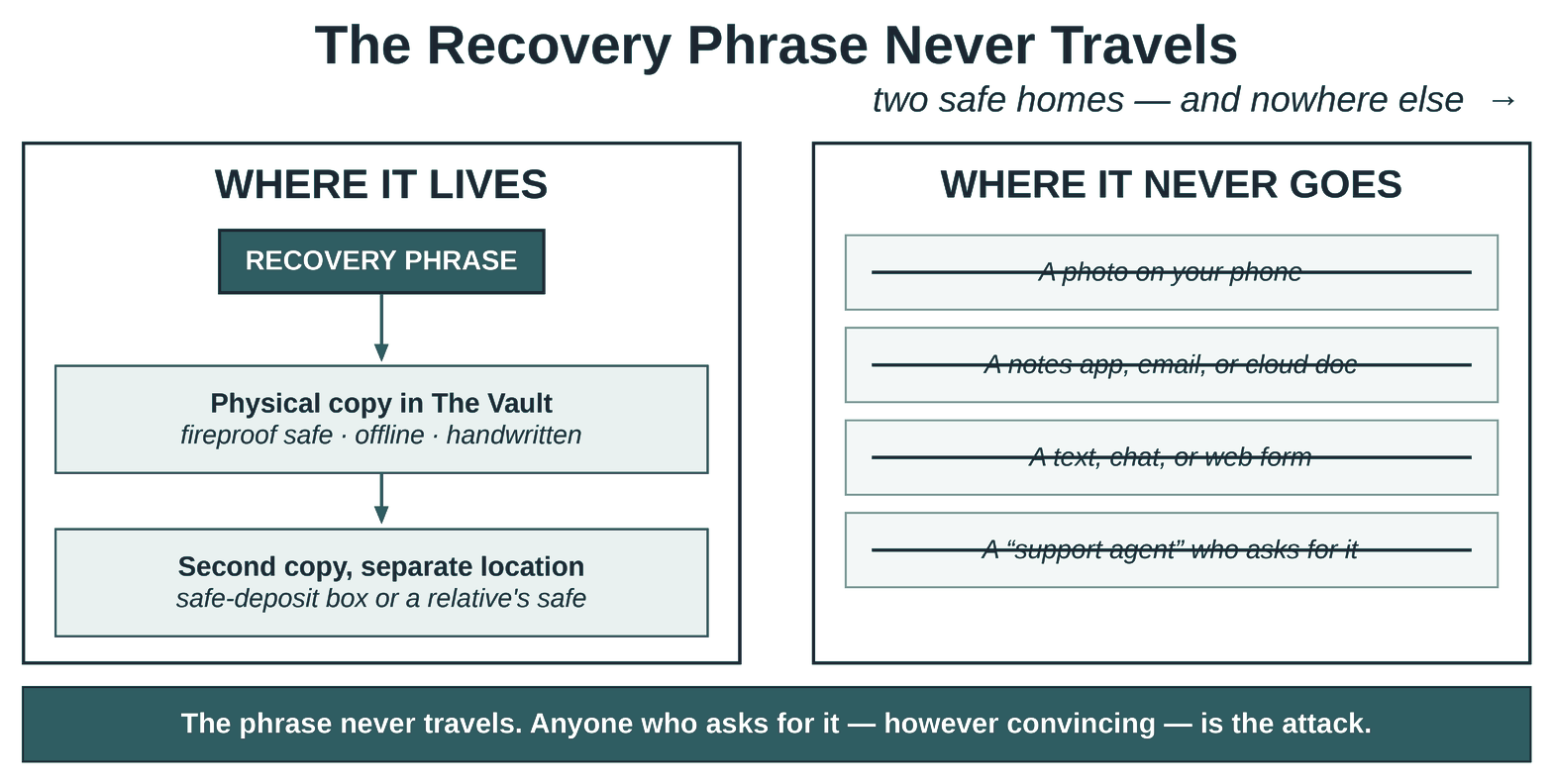
First, the phrase gets exactly two homes, both offline. Write it by hand, twice. One copy goes in the Vault, your fireproof physical storage at home. The second goes to a separate secure location, a safe-deposit box or a trusted relative’s safe, so no single fire or burglary takes both. Then test what you wrote; Robert confirmed his copies by running a recovery on a second device. A wrong word discovered now is an inconvenience. Discovered by your heirs, it is the end of the story.
Second, the phrase never goes anywhere else. Not a photo on your phone. Not a notes app, an email, or a cloud document. Not a text, a chat window, or a web form. And never a “support agent,” however knowledgeable, however urgent, however much they already correctly know about you. No exchange, wallet maker, attorney, or tax preparer legitimately needs your recovery phrase. The request is the attack, every time.
That absoluteness is the strength. Today’s scams are patient, personalized, and convincingly human, built to manufacture the one urgent moment when breaking a rule seems reasonable. A rule with no exceptions needs no judgment under pressure: the answer is always no, and every adult in your family can learn to give it.
One habit guards the side door: the exchange account behind the asset, and the email address that can reset it, deserve the strongest sign-in protection your family uses anywhere. An attacker who owns the email owns the exchange; if either account still leans on a text-message code for recovery, close that door too.
Where this lives in the family’s plan
If you are new here: the FIRM System (FIRM stands for Family Information Resource Management) is the organizational system at the heart of The Recoverable Family; its job is making sure the right person can reach the right information at the right time. Cryptocurrency is its sharpest test. The Vault holds the phrase. The Secure Guide holds the inventory and the access plan. The Family Guide says the assets exist and who to call. And your digital executor knows the sequence.
Tonight’s first step
The book calls the check Find the Phrase: if you hold any cryptocurrency, can you put your hands on the recovery phrase right now, and is it written somewhere that is not a photo, a note app, or an email? If yes, add the one-line note to your Family Guide tonight; you are most of the way home. If no, this moves to the top of your list: it is the only task where waiting can make the asset unrecoverable.
Frank’s Bitcoin got a second chance because there was still time to do it right. A recovery phrase that travels is an asset that vanishes — a phrase with two safe homes, and a single line telling your family it exists, is an inheritance. Where would your family land today: Emerging, Developing, or Recoverable? The Self-Assessment answers in about two minutes.